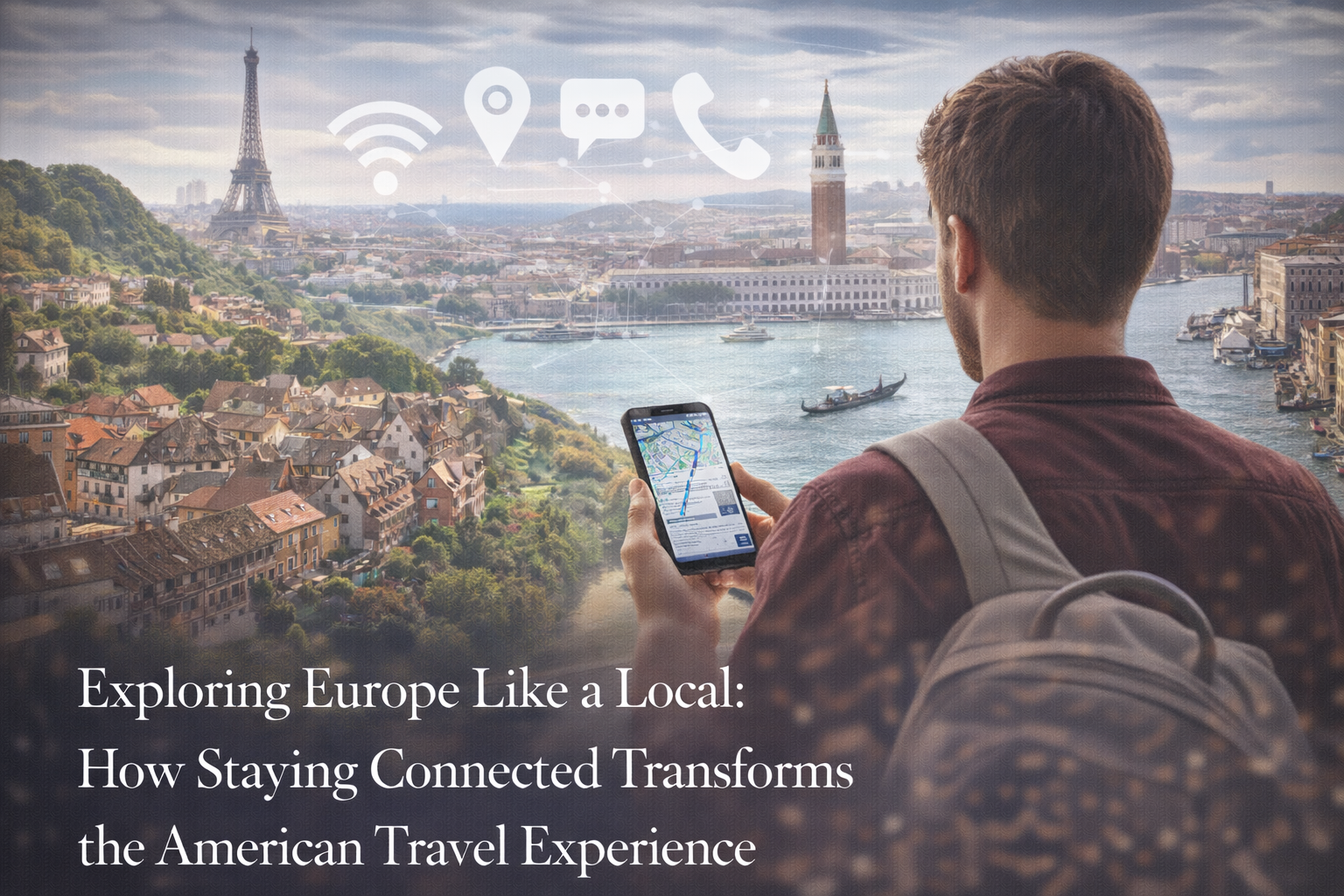
Exploring Europe Like a Local: How Staying Connected Transforms the American Travel Experience
For many Americans, traveling to Europe is more than a vacation. It is a journey into history, culture, and often personal heritage. Whether tracing family roots in Eastern Europe, wandering through the streets of Rome, or discovering coastal villages in Portugal, Europe offers a layered experience that blends old-world charm with modern vibrancy.
Yet as romantic as cobblestone streets and centuries-old architecture may be, the modern traveler depends heavily on something far less visible: reliable digital connectivity.
In today’s world, the ability to stay connected shapes how Americans experience Europe — how they navigate cities, discover hidden gems, communicate across time zones, and share meaningful moments with loved ones back home.
Beyond the Postcard: Traveling Deeper Into Europe
American travelers are increasingly venturing beyond the iconic landmarks. Instead of simply checking off Paris, London, or Barcelona, many are exploring smaller towns, countryside regions, and cultural enclaves that offer more authentic experiences.
They take regional trains through Tuscany, rent cars to explore rural France, attend local festivals in Romania, or spend quiet mornings in Greek island villages. These experiences often require flexibility and spontaneous decisions.
Reliable mobile access becomes essential for:
- Navigating public transportation systems
- Translating menus and street signs
- Booking last-minute tickets or tours
- Locating lesser-known attractions
- Checking updated opening hours
When you step outside major tourist centers, information is not always readily available in English. Having real-time access to maps and translation tools transforms uncertainty into confidence.
Multi-Country Itineraries and Modern Expectations
Unlike domestic travel within the United States, European trips often involve crossing several borders in one journey. A single itinerary might include Spain, France, and Italy within two weeks. High-speed trains and short flights make it easy to move from one country to another — but digital logistics can become complicated.
Roaming charges, SIM card changes, and inconsistent coverage can interrupt the flow of travel. For Americans accustomed to seamless connectivity at home, these interruptions can feel disruptive.
Travel today is not just about sightseeing. It includes:
- Coordinating with Airbnb hosts
- Managing digital boarding passes
- Accessing restaurant reservations
- Navigating ride-share apps
- Confirming museum entry times
A stable connection ensures that each transition feels smooth rather than stressful.
Staying Close While Far Away
For many American travelers, especially those traveling for extended periods, staying connected with family back home is deeply important. Parents want to check in with children. Grandparents want to share photos instantly. Couples traveling separately for work want reliable video calls.
Time zone differences already make communication more complex. Unstable internet should not add to that challenge.
Reliable mobile data allows travelers to maintain meaningful connections across continents. Sharing a sunset from Santorini or a Christmas market in Vienna in real time makes the experience more communal — even from thousands of miles away.
Safety, Security, and Peace of Mind
Traveling internationally also comes with practical concerns. Unexpected train delays, transportation strikes, or weather changes can disrupt plans. Having immediate access to information provides reassurance.
Mobile connectivity allows travelers to:
- Receive emergency alerts
- Monitor flight changes
- Navigate unfamiliar neighborhoods safely
- Access local healthcare information
- Contact accommodations instantly
In unfamiliar environments, digital access functions as both a guide and a safety tool.
Preparing Digitally Before Departure
Just as travelers carefully plan accommodations, excursions, and dining reservations, digital preparation has become part of the process.
Instead of relying solely on public Wi-Fi networks in airports or cafés — which can be unreliable or insecure — many travelers now seek solutions that provide consistent access across multiple European countries.
For Americans moving fluidly between destinations, choosing to get unlimited data in Europe with Holafly can simplify connectivity. Having access arranged before departure eliminates the need to search for local SIM vendors upon arrival or worry about fluctuating roaming costs.
This approach supports a smoother transition from airport arrival to exploration, without logistical distractions.
Cultural Immersion Enhanced by Technology
There is a misconception that digital connectivity detracts from cultural immersion. In reality, it often enhances it.
Translation apps help travelers understand local customs. Audio guides provide historical context while exploring ancient sites. Online platforms connect visitors with community-led experiences and local artisans.
Rather than isolating travelers, connectivity can deepen engagement. It allows for spontaneous learning and richer interaction with local culture.
Balancing Presence and Access
Of course, meaningful travel also involves moments of disconnection — long meals without checking notifications, walks through historic districts without screens in hand. The goal is not constant online activity but reliable access when needed.
The freedom to disconnect confidently depends on knowing that connectivity is available at any time. That assurance reduces stress and allows travelers to be fully present.
Europe Through a Modern Lens
For American travelers, Europe remains a timeless destination. Yet the way it is experienced continues to evolve. Digital tools now accompany guidebooks and travel journals. Navigation apps replace folded maps. Real-time messaging replaces prepaid calling cards.
Connectivity has quietly become part of the travel infrastructure — as essential as transportation and lodging.
Exploring Europe like a local today means moving fluidly between cultures, cities, and experiences. It means having the flexibility to adapt plans, discover hidden corners, and stay connected to loved ones across the Atlantic.
In this new era of global mobility, seamless digital access does not diminish the magic of travel. Instead, it supports it — making every journey smoother, safer, and more enriching.
For Americans embracing Europe’s diversity, history, and charm, staying connected is no longer just practical. It is part of experiencing the continent with confidence and ease.













Post Comment