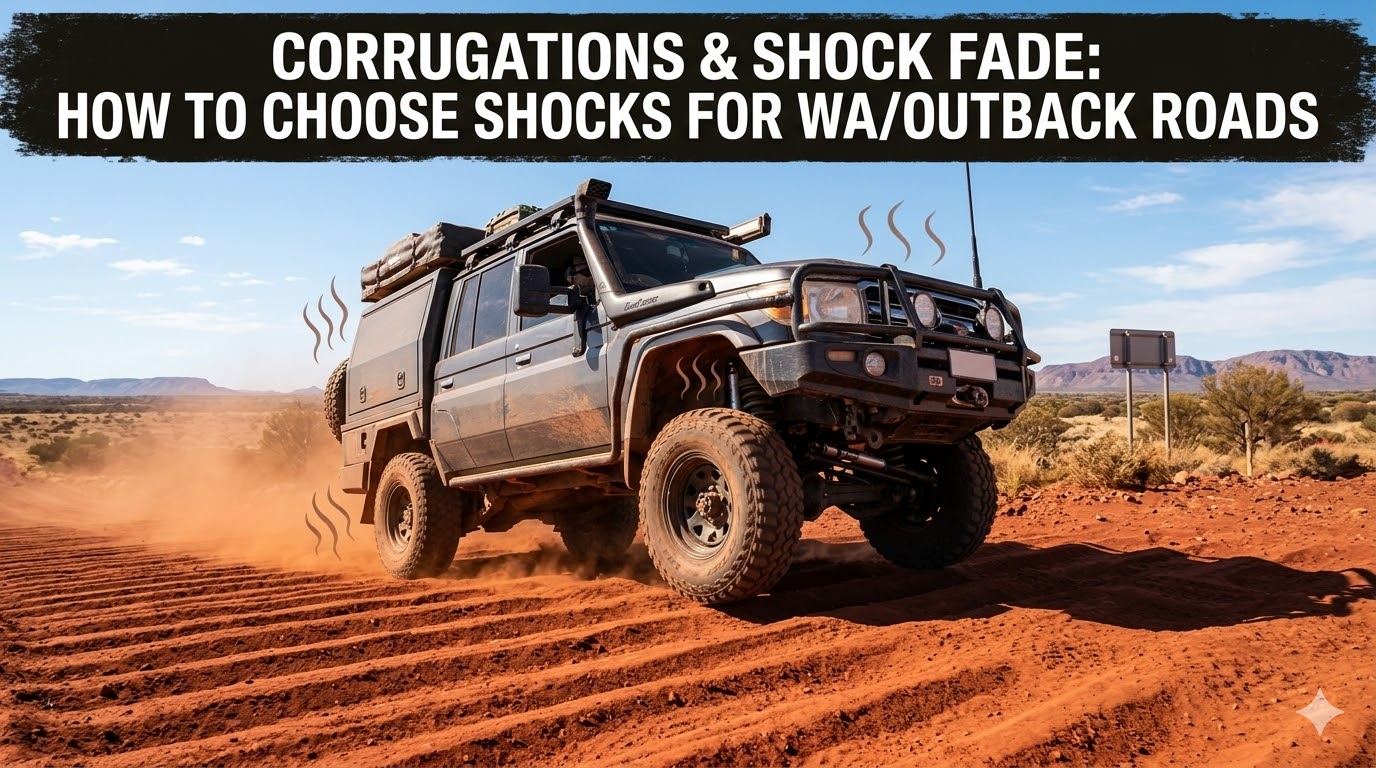
Best Shocks for Corrugations on WA and Outback Roads
Ask ten outback drivers about the best shocks for corrugations and you will get ten answers, plus one bloke telling you tyre pressures solve everything. The truth sits in the middle.
On WA and outback roads, especially the long rough sections where the surface goes from decent gravel to endless chatter, shock choice is mostly about one thing: heat. If a shock cannot manage heat, damping drops away, control gets vague, and the vehicle starts feeling busy, floaty, or plain annoying before the day is done.
Main Roads WA notes roads like the Gibb River Road can be corrugated and rocky, and that tyre pressure must suit both the load and the surface. Specialist 4WD accessories suppliers also separates their Suspension range by use, listing Nitro Gas for dependable comfort, Foam Cell for better heat dissipation, Foam Cell Pro for extreme durability, and remote-reservoir Fox options for stronger off-road damping.
Corrugations Cook Shocks Faster than Most People Think
Corrugations are not one big hit. They are thousands of small hits, one after another, for hours. That is why shock fade sneaks up on people. Put simply, shock fade is what happens when repeated movement builds heat in the damper and the control you had at the start of the road is not the control you have later on.
The result is more bounce, less composure, and a vehicle that feels less settled over the same surface. That is exactly why heat management keeps showing up in proper shock design.
The key to 4WD shock performance is dissipating heat created by articulation and corrugations, while on the other hand 46 mm monotube design is aimed at consistent, fade-free performance and that larger reservoir shocks use greater oil capacity to control heat over rough surfaces and long distances.
There is No Magic Shock, Only the Right Match
This is the bit buyers sometimes skip. There are no universal best shocks for corrugations if the vehicle setup is wrong. A lightly loaded Ranger that mostly tours with camping gear wants something different from a canopy-equipped LandCruiser carrying drawers, water, a spare set of tools, and a tow ball load on top.
There is one simple fact that one size does not fit all, and that good damping is tuned to the specific vehicle and use factors including load, towing, and tyre pressure. The same logic runs through the Shocks and Struts and 2 Inch Lift Kits, where different spring rates and shock types are matched to how the vehicle is built and used.
Start with Heat Management
If the vehicle spends real time on corrugated roads, heat management matters more than bragging rights about lift height. Entry-level dampers can be perfectly fine for a daily driver and light touring, but once the pace is up, the load is up, and the road keeps drumming away for hours, more oil volume and better cooling become a big deal.
That is why foam cell, monotube, and reservoir designs keep coming up in outback suspension conversations. Foam Cell is aimed at better heat dissipation, Foam Cell Pro at extreme durability, and Fox 2.5 Remote Reservoir shocks at superior off-road damping.
Foam Cell also states the design runs with 50 percent more oil for cooler running, which is exactly the sort of thing that matters when the road surface is trying to turn your shocks into kettles.
That does not mean every touring rig needs a big-dollar remote reservoir setup. It means buyers should be honest about the trip. If the vehicle mostly sees local gravel and the odd weekend away, a solid foam-cell or monotube touring shock can be enough.
If it is doing WA station roads, outback highways, long corrugated stretches with load in the tray, and repeated hot-weather touring, stepping up to a shock designed for higher oil volume and more stable damping starts making proper sense.
Damping is About Control
A lot of people describe shocks by saying one feels softer and one feels firmer. That is only half the story. Damping is really about control. Good damping stops the tyre from skipping around, keeps the body from bouncing after each hit, and helps the vehicle settle quickly instead of floating across the next fifty corrugations like a tinnie in chop.
That is why touring suspension setup is not just about bolting in a firmer shock. Too much damping can make a vehicle feel harsh and nervous. Too little can let it wallow and overwork the damper.
The lesson is simple. Pick the damper for the road and the load, not because the catalogue photo looks tough.
Tyre Pressures Matter More than Most Shock Upgrades Admit
Here is the uncomfortable truth. Plenty of people blame their shocks when their tyre pressures are miles off. On corrugations, tyres are part of the suspension system. Main Roads WA says tyre pressure should suit the weight being carried and the road surface, and RAC WA goes a step further by recommending that on corrugated roads you reduce tyre pressures to suit the conditions.
RAC WA also says that if the shocks are too hot, you are either driving too fast or tyre pressures are too high. That is a very tidy outback reality check. No fancy sales pitch, just cause and effect.
The key thing is not chasing somebody else’s magic PSI figure off a forum. A loaded wagon, a tray-back ute, and a lightly packed dual-cab do not want the same number. A brief rule that actually helps is this: set pressures to the vehicle, load, and surface, then watch how the vehicle behaves.
If it is skating, chattering, and hammering the cabin, the setup probably needs work. If the ride calms down and the shocks stop getting cooked so quickly, you are heading in the right direction.
Do Not Ignore the Rest of the Suspension Package
This is where many “shock upgrades” fall over. A shock can only control what the rest of the setup gives it. Springs matter. Load rating matters. Geometry matters. Coil and Leaf Springs support load and ride performance, while Upper Control Arms help maintain proper geometry after lifting.
That matters because a shock trying to manage corrugations on a badly matched spring package is doing cleanup work all day. And if the bushes, mounts, or hardware are tired, the Spare Parts and Components side of the system can undo the nice new dampers in a hurry.
For plenty of outback rigs, a sensible touring suspension setup looks boring on paper. A modest lift, the right spring rate for the constant load, a damper with decent oil volume and cooling, and everything underneath in good nick. That sort of setup usually outperforms a flash lift with the wrong spring choice and overheated shocks by day two.
What to Buy If WA and Outback Corrugations are the Real Job
If the vehicle is mainly a daily driver with occasional gravel, start with a quality touring shock and match it to your real load. If it is a proper touring build that regularly sees long corrugated roads, hot weather, and extra weight, put heat management at the top of the list and start looking harder at foam-cell, monotube, or reservoir-based options.
If the rig is lifted, loaded, and expected to hold its composure over long rough sections, the whole package needs to work together, not just the shiny bits in the damper description.
Set it Up Before the Road Shakes it Apart
The right answer to best shocks for corrugations is usually less dramatic than people hope. Buy for heat control, buy for the real load, and buy for the speed and distance the vehicle actually covers. Then give the tyres a fair say, because no shock likes being asked to fix bad pressures and bad driving at the same time.
That is where a trusted Australian off-road accessories supplier earns its keep. Not by pushing the most expensive damper on the shelf, but by helping match a complete Suspension setup to the sort of WA and outback roads that keep shaking long after the novelty wears off.













Post Comment