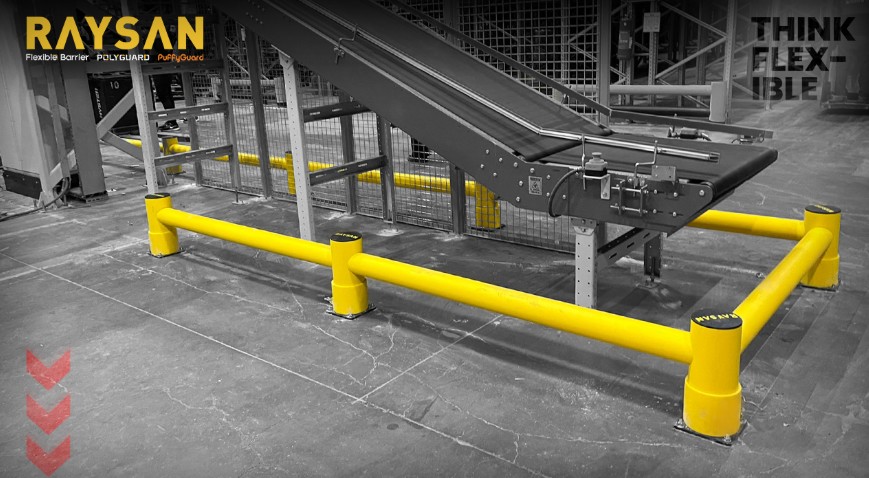
Structured Industrial Movement: Strengthening Workplace Protection with Pedestrian Barrier Routing and Safety Barrier Impact Control
In industrial sites, safety is shaped by the same variable that drives productivity: movement. Forklifts, pallet trucks, and automated equipment travel continuously, while employees and visitors navigate between work areas, offices, and loading points. When these flows share space without physical separation, risk becomes a predictable outcome—not a rare exception.
Modern facilities reduce that risk by engineering traffic rules into the layout itself. Instead of relying solely on signage or reminders, they implement visible, enforceable systems that guide people, restrict vehicles, and manage the energy of accidental impacts.
This is the foundation of the approach delivered by Raysan solutions designed to protect people and infrastructure while preserving operational flow in high-activity environments.
Why Workplace Incidents Often Start with Unclear Boundaries
Many industrial incidents occur in familiar locations: aisle intersections, staging zones, blind corners, and loading interfaces. These are the areas where speed, limited visibility, and competing priorities create momentary decision pressure. Without clear movement boundaries, pedestrians take shortcuts, vehicles drift toward work areas, and crossings occur without warning.
Effective protection therefore depends on two complementary objectives: (1) enforce safe pedestrian routing and (2) protect critical zones from vehicle impacts. When both objectives are addressed, the facility becomes easier to navigate, safer to operate, and more resilient under peak workload.
Pedestrian Barrier: Turning Guidance into Enforceable Routes
A pedestrian barrier is most effective when it does more than “mark” a walkway. It creates a physical separation that makes correct behaviour natural and consistent. By channelling foot traffic into defined corridors, the system reduces unpredictable crossings and helps vehicle operators anticipate pedestrian movement.
In fast-paced operations, visibility matters. High-contrast barrier design and consistent placement improve recognition, support training for new personnel, and reduce the reliance on constant supervision to keep routes respected.
Practical workplace benefits commonly include:
- Predictable walking routes that reduce surprise crossings in active forklift lanes
- Restricted access to high-risk zones such as staging areas, loading bays, and turning corridors
- Improved orientation for visitors and contractors in unfamiliar environments
- A more disciplined traffic culture supported by physical, repeatable boundaries
Safety Barrier Systems: Protecting Infrastructure by Managing Impact Energy
Even with strong traffic discipline, industrial environments will experience contact events. Pallets overhang, turning clearance is tight, and equipment operates under time pressure. The question is not whether impacts happen—but whether the facility is engineered to control their consequences.
A safety barrier system protects high-value infrastructure such as racks, machinery, columns, and wall edges. The objective is to intercept collision energy before it damages structural elements or interrupts workflow. When barriers absorb and distribute force effectively, facilities experience fewer repairs, fewer stoppages, and more stable daily performance.
This matters operationally as much as it matters for safety. A damaged rack end or compromised machine perimeter can trigger route reconfiguration, slower picking, and secondary hazards as teams work around the affected zone.
Typical high-value applications include:
- Racking ends and uprights exposed to repeated contact in narrow aisles
- Corners and intersections where turning radius increases strike probability
- Machinery perimeters and utility zones where impact can shut down production
- Walkway-adjacent boundaries that reinforce separation between people and vehicles
Dual-Barrier Strategy: When People Protection and Asset Protection Work Together
The most reliable facilities treat pedestrian protection and impact protection as one integrated traffic architecture. Pedestrian barriers define where people move. Safety barriers protect the physical environment where vehicles operate. Together, they reduce interaction points, stabilise routes, and create a site that remains navigable—even during peak demand.
In practice, a dual-barrier strategy supports outcomes such as:
- Clear separation between pedestrian corridors and vehicle operating zones
- Lower likelihood of vehicle–personnel interaction in critical interfaces
- Reduced infrastructure damage and fewer unplanned maintenance interventions
- More consistent productivity due to fewer disruptions and workarounds
Durability and Long-Term Value in High-Activity Facilities
Protection systems should be evaluated on long-term performance. In active environments, frequent repainting, corrosion treatment, or component replacement creates downtime and increases total cost. Barrier solutions that retain visibility and function with minimal intervention help keep safety consistent year after year.
When durability is paired with a structured deployment plan—prioritising the highest-risk zones first—facilities can scale protection efficiently as layouts evolve.
Conclusion: Proactive Safety as a Layout Outcome
Workplace safety improves most when it is built into the physical environment. A pedestrian barrier establishes enforceable routes for people, while safety barrier systems protect infrastructure by controlling the impact energy of inevitable contact events.














Post Comment