Business Properties Aggr8Investing: A Practical Guide to Smarter Asset Growth
Introduction
“Business properties aggr8investing” Investing in real-world assets offers one of the more tangible ways to build long-term wealth. In recent discussions, the term business properties aggr8investing has emerged as a method to leverage commercial or business-oriented real estate and other “property” assets with a structured investment mindset. In this guide, we will explore what business properties aggr8investing means, how it works, why it matters, the benefits and risks, and how investors of different experience levels can approach it.
What Is Business Properties Aggr8Investing?
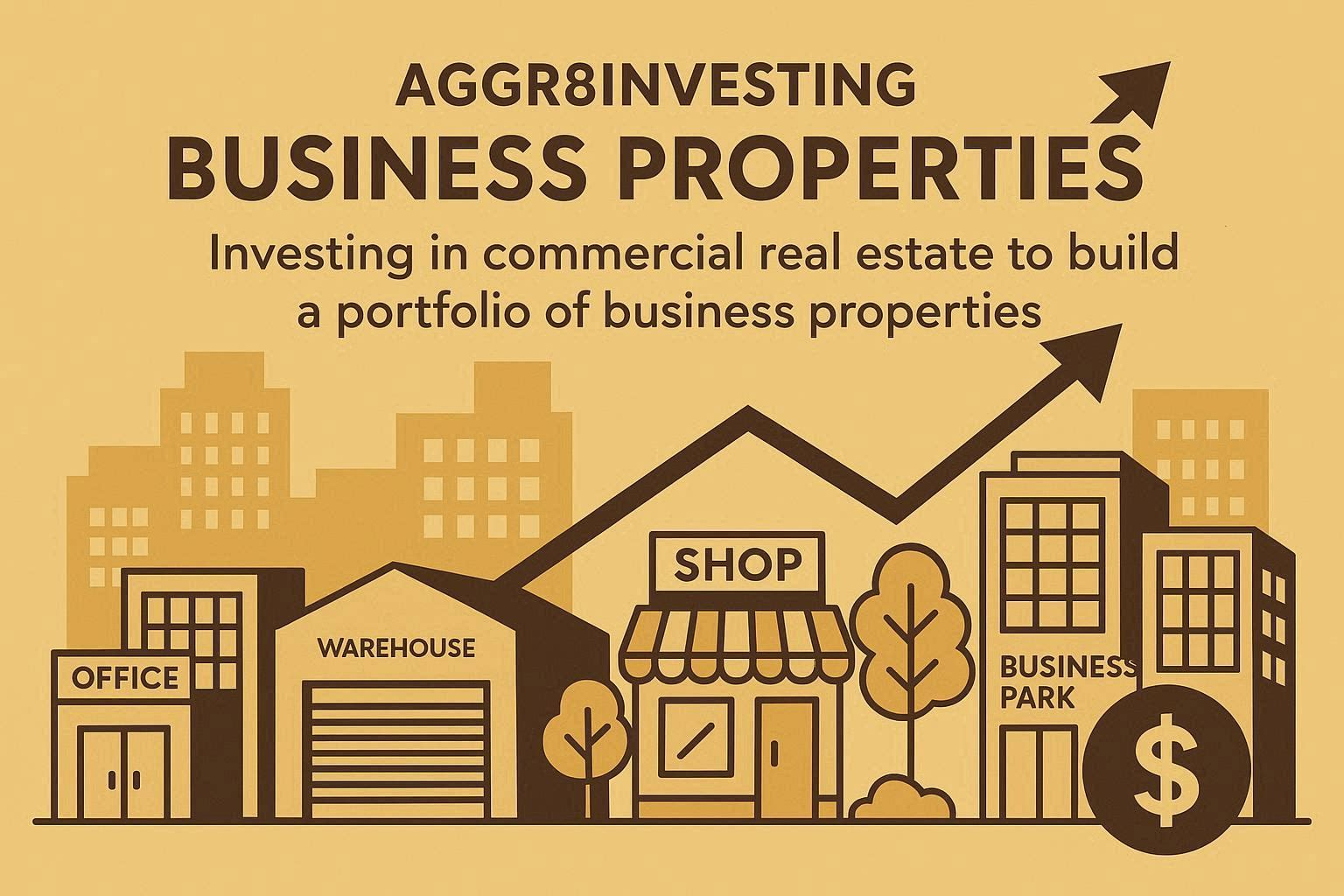
At its core, “business properties aggr8investing” refers to investing in properties that are used for business/commercial purposes (such as offices, retail shops, warehouses, business parks) with the mindset of aggregation (i.e., bringing together multiple assets, or pooling capital) and “8” implying perhaps an amplification, growth or multiplier effect. The term “Aggr8Investing” (pronounced “aggregate investing”) suggests a strategy of collectively investing in business properties to achieve greater returns or stability than individual, standalone real estate investments.
In practice, business properties aggr8investing involves:
- Identifying business-use real estate assets (rather than purely residential)
- Applying an investment framework that emphasises aggregation: owning multiple properties or segments, rather than one-off purchases
- Focusing on how business properties produce income (through leases, rentals, business tenancy) and appreciation
- Managing and monitoring these assets with an investment mindset (return on investment, cost control, risk mitigation)
Thus, business properties, as aggr8investing blends the real estate asset class with a disciplined investment strategy.
Why Business Properties Matter in Aggr8Investing
Business-property assets differ from residential properties in several important ways, which make them attractive for a strategy like business properties aggr8investing:
- Income generation potential: Commercial/business properties tend to generate rental income from business tenants, which can be higher (or have longer lease terms) compared to typical residential leases.
- Professional tenants: Businesses leasing property often sign longer lease agreements than residential tenants, providing more predictable cash flows.
- Asset appreciation: As businesses grow or demand for commercial space in a location rises, the value of business properties can increase significantly.
- Diversification: For investors accustomed to residential real estate, shifting or adding business properties expands the asset base and reduces concentration risk.
- Strategic positioning: Through aggregation (i.e., owning multiple business properties across location types or sectors), investors can spread risk—this is the “aggr8” (aggregate) component of business properties aggr8investing.
In short, business properties matter in the context of the “aggr8investing” approach because they offer an alternative property-investment pathway with unique characteristics suited for long-term, growth-oriented investment.
How Business Properties Aggr8Investing Works
The process of implementing a business properties aggr8investing strategy can be broken down into several key steps:
Step 1: Define investment objectives
Before acquiring any properties, an investor must clarify:
- What is the target return (rental yield + appreciation) for business properties?
- What is the time horizon (5 years, 10 years, 20 years)?
- What level of risk is acceptable (tenant risk, vacancy risk, location risk)?
- How many properties or how much capital will be aggregated?
Step 2: Identify suitable business-use properties
Not all properties qualify for this strategy. Investors look for:
- Commercial or business-use buildings (offices, warehouses, retail spaces, business parks)
- Good location: high business-traffic zones, stable economic areas, growing business districts
- Lease structure: long-term leases, credit-worthy tenants, favourable terms
- Condition of asset: minimal major repairs required, or a realistic renovation plan
- Clear exit strategy: can the property be sold or re-leased if needed?
Step 3: Acquire and aggregate assets
Once suitable properties are found:
- Perform due diligence (legal, structural, tenant leases, compliance)
- Acquire the property (or properties) gradually, building an aggregated portfolio of business properties
- Manage all assets collectively, leveraging economies of scale (for maintenance, property management, tenant sourcing)
- Track performance at both individual-asset and portfolio levels (rental income, occupancy rates, maintenance costs, capital appreciation).
Step 4: Income generation and ongoing management
With the portfolio assembled, the investor focuses on maximizing returns:
- Ensure good tenant retention and occupancy
- Regularly review lease terms, and where possible negotiate favourable renewals
- Monitor and refurbish properties to maintain attractiveness to business tenants
- Use property management techniques to optimise operational costs and revenue
- Reinvest surplus income into additional business properties or into existing ones to enhance value.
Step 5: Exit/realise value or hold for long term
Depending on the investor’s objectives:
- Hold the business-property portfolio for long-term passive income and appreciation
- Or sell some assets after value uplift, redeploying capital into new business properties as part of the aggr8investing cycle
- Monitor market trends to decide whether to hold, upgrade, sell, or expand.
Key Benefits of Business Properties Aggr8Investing
Adopting a business properties aggr8investing approach offers several notable advantages:
Benefit 1: Potential for higher yields
Business properties can offer higher rental yields compared to comparable residential assets because of business tenant requirements and larger space usage.
Benefit 2: Stronger lease security
Commercial/business leases often involve longer terms, reduced tenant turnover, and sometimes rental escalations built into the lease contract.
Benefit 3: Portfolio diversification
By aggregating multiple business properties — across different kinds (office, retail, warehouse) or locations — you spread risk and reduce dependency on a single asset.
Benefit 4: Asset value growth
In well-chosen locations, demand for business-use real estate tends to grow, which can translate into capital appreciation in addition to rental income.
Benefit 5: Professional asset management mentality
Because business properties require more active management than simple residential rentals, adopting a portfolio mindset (aggregation, performance tracking, optimisation) can lead to superior outcomes over time.
Benefit 6: Scalability
The “aggr8” part of business properties aggr8investing implies that once you acquire one good asset and optimise it, you can scale by acquiring further properties, thereby building an investment engine rather than a one-off purchase.
Finding the Right Business Properties in an Aggr8Investing Framework
Selecting the correct assets is critical. Here are the key criteria and tips:
Location analysis
- Business properties perform well when located near strong business districts, transport hubs, high-traffic commercial zones.
- Check local economic indicators: business growth rate, new company beginnings, employment rates in the region.
- Consider future infrastructure developments: roads, transit, business parks that might boost demand.
Tenant quality and lease terms
- Prioritise tenants with strong creditworthiness or businesses in stable sectors.
- Long lease terms (5-10 years+) with built-in rent escalation provide predictable cash flows.
- Check lease clauses for maintenance responsibilities, tenant obligations, and renewal options.
Physical condition and suitability
- A property requiring minimal immediate major renovation is preferable.
- Ensure zoning, compliance, and business-use permissibility are clear.
- Evaluate maintenance history, structural risks,and hidden costs.
Financial metrics and return calculation
- Calculate rental yield: annual rent ÷ acquisition cost.
- Include vacancy allowance and maintenance costs in yields.
- Estimate appreciation potential: growth in area, asset upgrades, and business demand.
- Consider property management costs, tax implications, insurance, and legal fees.
Aggregation potential
- Look for properties that can be pooled under one management structure (for scale).
- Synergies: one management team for multiple sites, bulk maintenance contracting, shared marketing.
- Portfolio diversification: different property types, different regions, thereby reducing singular-asset risk.
Exit strategy
- Plan how you will realise your investment: hold long term? sell when value uplifts? reposition?
- Consider liquidity risk: business properties can take longer to sell compared to residential.
- Review market cycles: are you buying at a peak? Is there demand for the asset type in the future?
Managing Business Properties Effectively in an Aggr8Investing Strategy
Acquisition is only part of the story. Effective management keeps the engine running.
Tenant relationship management
- Keep open lines of communication with tenants; a satisfied tenant tends to renew.
- Address maintenance, repairs, and any operational issues promptly.
- Monitor lease performance: ensure tenants meet obligations, track rent collection timeliness, and escalation terms.
Maintenance and refurbishment
- Budget for regular maintenance (building systems, common areas, facade) to preserve value.
- Consider upgrading assets periodically to meet evolving business needs (for example: co-working spaces, modern warehouses).
- Use professional property managers if you own multiple assets; scale works better when you leverage external expertise.
Performance tracking and optimisation
- Maintain a dashboard of key metrics: occupancy rate, rental rate per square foot/metre, maintenance cost ratio, tenant turnover, net operating income, and return on investment.
- Review performance quarterly or semi-annually and adjust strategy if a property underperforms (e.g., renegotiate lease, reposition asset, increase marketing).
- Use benchmarking: compare your portfolio performance against similar business properties in your region.
Risk control
- Maintain a cash reserve for vacancies, major repairs, and changes in the business environment.
- Avoid over-leveraging: high debt amplifies risk if business properties sit vacant or lease terms are renegotiated downward.
- Stay informed on regulatory changes: business-use zoning, tax incentives, and changes in business property demand.
- Diversify across property types and locations so that a downturn in one segment does not cripple the entire portfolio.
Reinvestment and growth mindset
- Use returns (rental income and/or property sale profits) to acquire additional business properties; this is the “aggr8investing” growth loop.
- As you scale, you may reach a point where you own enough assets to negotiate better management contracts, bulk maintenance, and greater operational efficiencies.
- Continually revisit your portfolio and consider repositioning underperforming assets into higher growth ones.
Target Audiences for Business Properties Aggr8Investing
This strategy is adaptable to different types of investors:
Beginners / first-time investors
- You may start small: for example, a single business property with conservative debt and hold for steady rental income.
- Use it as a learning experience: acquire one property, manage it well, then scale into aggregation.
- Ensure you understand the additional complexity business properties bring vs residential (tenant types, lease negotiations, commercial regulations).
Established real-estate investors
- If you already have residential properties and want diversification, business properties offer a new asset class.
- Use your existing management infrastructure or build a new one for commercial assets.
- Focus on aggregation: owning two, three, or more business properties provides greater scale and potential returns.
Business owners/entrepreneurs
- If you own a business and need property, you might purchase your own business property under the business properties aggr8investing mindset—lease it to your business or a related entity, build equity while your business grows.
- Once you have one property, you might add further assets (for example, leasing to your business or others) and engage in the aggregation strategy.
Institutional or semi-institutional investors
- For those with larger capital, this strategy can be run like a small-portfolio business-property fund: acquire multiple assets, operate them under one management company, monetise rental income, schedule growth, and exit strategy.
- The “aggr8investing” loop (acquire → manage → rent → reinvest) works well at scale.
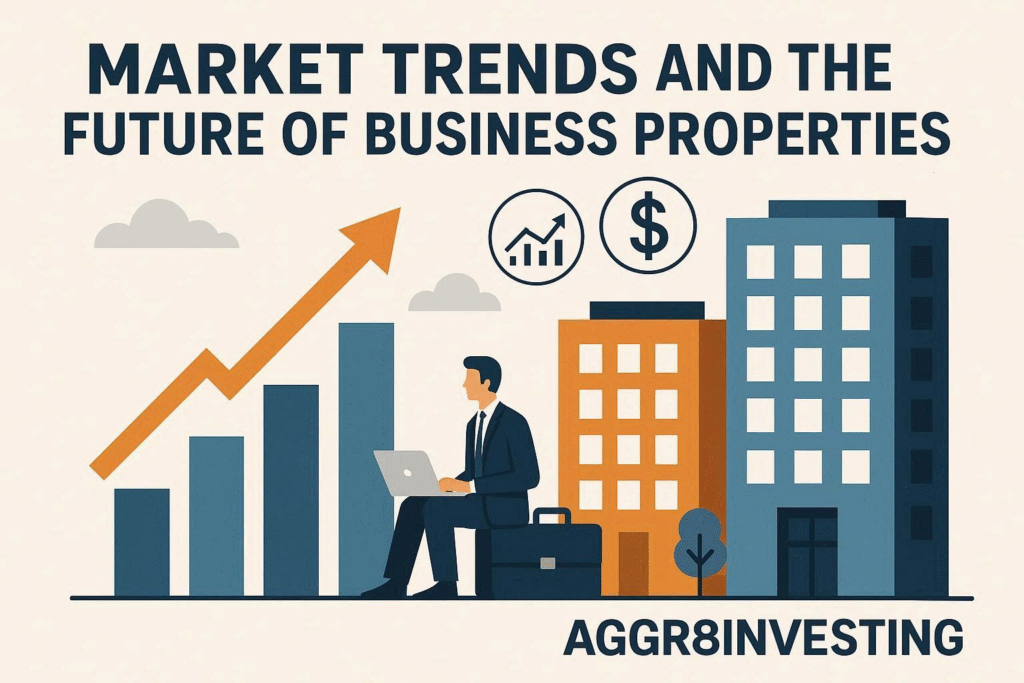
Market Trends and the Future of Business Properties Aggr8Investing
Understanding the broader market context is important for any investment strategy, including business properties aggr8investing.
Demand drivers
- Growth in industries needing business space: technology firms, logistics/warehousing (especially with e-commerce growth), flexible office/co-working spaces.
- Redevelopment of older industrial/commercial zones into modern business parks.
- Infrastructure improvements that enhance the access and attractiveness of business properties.
Technological impacts
- Smart buildings, Internet-of-Things (IoT) enabled systems, and sustainability certifications (LEED, BREEAM) are increasingly demanded by business tenants.
- Property-tech (“PropTech”) platforms allow better management of assets and aggregation across multiple sites.
- Data analytics for tenant behaviour, building usage, and predictive maintenance all enhance returns and lower costs.
Sustainability and ESG (Environmental, Social, Governance) focus
- Business properties with green credentials increasingly attract premium rents and lower vacancy risk.
- Investors who integrate sustainability into their aggregation strategy of business properties aggr8investing may have a competitive advantage.
Challenges & potential headwinds
- Shifts to remote working may reduce demand for traditional office spaces; strategy must evolve (e.g., mixed-use or flexible business spaces).
- Economic downturns may hit businesses, causing lease renegotiations or higher vacancy rates.
- Regulatory changes, zoning laws, or business-property tax increases can impact returns.
- Entry costs and due diligence are higher for commercial assets versus residential. This means good property selection and management are key.
Future outlook
The “aggr8investing” concept in the business-property context is likely to evolve with:
- More pooling or co-investment models for business properties (smaller investors participating in larger assets).
- Use of digital platforms to aggregate business property assets, monitor performance, and streamline investor access.
- Greater integration of flexible business property models (shared offices, modular warehouses) is making the investment universe broader.
- As business property investment becomes more accessible, competition may increase – making location, tenant quality, and management ever more important.
Challenges and Risks of Business Properties Aggr8Investing
While the benefits are substantial, the strategy comes with risks and challenges that must be managed carefully.
High entry cost
Commercial/business-use properties typically cost more than residential ones. Aggregation amplifies capital needs (you’re acquiring multiple assets). This can limit accessibility for smaller investors unless they pool capital or use co-investment structures.
Less liquidity
Selling business properties can take longer than residential ones, especially in a weak market. Aggregation may reduce flexibility if funds are locked in multiple assets.
Vacancy and tenant risk
If a business tenant leaves, the downtime until a new tenant is found can impact income. Commercial tenants may also default or negotiate new lease terms. Aggregation helps mitigate by spreading risk, but each property must still be managed.
Market and economic cycles
Commercial real-estate markets are more sensitive to changes in business activity, economic downturns, changes in trade, and logistics. If demand drops, rental income and appreciation may suffer.
Complexity of management
Operating multiple business properties requires professional management, more detailed lease oversight, zoning and compliance issues, and sometimes capital expenditure. The “aggr8” strategy demands operational scale, not just passive ownership.
Over-concentration
While aggregation is good, concentration in one region, one type of property, or one tenant type can amplify risk. A diversified portfolio is essential.
How to Get Started with Business Properties Aggr8Investing
Here is a step-by-step beginner’s guide to launching your own business properties aggr8investing approach.
1. Educate yourself
- Learn commercial property basics: lease types (gross, net, triple-net), tenant law, commercial zoning, and building standards.
- Study investment concepts: net operating income (NOI), capitalization rate (“cap rate”), internal rate of return (IRR), vacancy rate, and tenant creditworthiness.
- Review case studies of business-property portfolios (how they were acquired, managed, exited).
2. Define your strategy
- Choose your property type(s): offices, retail, warehouse, business parks.
- Decide target geography/market: local, regional, international?
- Set financial goals: target yield, appreciation, time horizon.
- Decide portfolio size: how many properties or how much capital to invest initially—and how to scale.
3. Form or use an appropriate investment vehicle
- You may invest personally, via a limited liability company, partnership, or through a pooled fund/co-investment.
- Ensure legal structure allows aggregation of assets, professional management, and scalability.
4. Build a property-selection pipeline
- Network with brokers specialising in business/commercial properties.
- Use site visits, property tours, building inspections, and tenant interviews.
- Analyse each prospective asset: location, tenant, lease term, condition, cost, potential for upgrade/renovation.
5. Perform thorough due diligence
- Legal: verify title, zoning, lease agreements, and tenant covenants.
- Financial: verify rent roll, occupancy history, operating expenses, capital expenditure history.
- Physical: hire building inspectors, review structural and mechanical systems, and assess environmental risk.
- Market: evaluate supply/demand dynamics in the area, competitive properties, and trends in business tenancy.
6. Acquire and manage
- Negotiate purchase based on investment objectives (yield, cap rate, growth potential).
- Structure financing: cash vs debt; maintain conservative leverage to protect risk.
- Upon acquisition, implement a property-management plan: marketing, tenant retention, maintenance schedule, and cost control.
- Monitor performance: track key metrics for each asset and for the aggregated portfolio.
7. Scale and optimise the portfolio
- Use returns (rental income + appreciation) to acquire additional business properties.
- Leverage synergies: bulk procurement of services, shared management, standardised reporting.
- Periodically review portfolio: upgrade weaker assets, sell those with less potential, reinvest proceeds into higher potential assets.
- Continue portfolio diversification: property types, geographies, tenant sectors.
8. Exit or hold long-term
- Plan exit strategy early: sell assets when value is maximised, or continue holding for passive income.
- If selling, ensure you time the market (or internal value creation) to realise appreciation.
- If holding long term, ensure you maintain the assets, keep them modern and competitive to maintain tenant demand.
Real-World Example (Hypothetical)
Here’s a simplified example of how a business properties aggr8investing strategy might play out:
- Investor A acquires an office building in a growing business district for USD 2 million. The building is leased to multiple tenants with an average lease term of 7 years, generating a net rental yield of 6%.
- Over two years, the investor improves building amenities (smart HVAC, communal workspace), increasing rents by 10%. The building’s appraisal value rises to USD 2.3 million.
- Instead of holding it alone, Investor A now acquires a second property (a warehouse leased to a logistics firm) for USD 1.5 million using capital + moderate debt.
- The portfolio now aggregates two business properties. Combined rental income, diversified tenant base (office + warehouse), longer lease terms, and higher combined value.
- After five years, rental income has grown via escalation clauses, and property values have risen in the region. Investor A sells one asset for USD 3 million, realizes a profit, and uses the proceeds to buy a third property in a new region—further scaling the aggregation strategy.
- By Year 10, Investor A holds three properties, each generating rental income, managed under one portfolio, with a total value of USD 8 million and an average yield of 7%. The “aggr8investing” loop has turned from one asset to a diversified income-producing portfolio.
Common Mistakes to Avoid
To succeed with business properties aggr8investing, avoid these pitfalls:
- Buying just because “it looks good” without checking lease terms, tenant strength, or area business demand.
- Over-leveraging: too much debt increases risk if vacancy or rental income drops.
- Failing to diversify: one property, one tenant, one region = concentrated risk.
- Ignoring ongoing management: business properties require higher management effort.
- Not considering an exit strategy or liquidity: business properties can be harder to sell quickly.
- Letting emotion drive decisions instead of data: property investment must be disciplined (yield metrics, cost control, risk modelling).
Is Business Properties Aggr8Investing Right For You?
Here are questions to help determine if this strategy fits your profile:
- Do you have sufficient capital (or access to capital/pooling) to acquire business-use properties?
- Are you comfortable with longer-term investments and possibly less liquidity than residential property?
- Can you either manage or hire professional property managers for business-use assets?
- Do you understand commercial/industrial real-estate leases and tenant requirements?
- Are you able to commit to the aggregation mindset, scaling through multiple properties rather than a one-off purchase?
- Are you prepared to perform due diligence and monitor key metrics regularly?
If you answered yes to most of these, then business properties aggr8investing may be a suitable path. If you prefer simpler, more liquid investments or lack the capital/management capacity, you might want to start smaller or consider residential property investment first.
Summary & Final Thoughts
Business properties aggr8investing represents a strategic, disciplined way to invest in commercial/business real-estate assets by aggregating multiple properties, managing them professionally, and scaling over time for income and appreciation. The benefits include higher rental yields, longer lease security, diversification, and potential for value growth. However, the approach demands more capital, higher management capability, and bears risks such as vacancy, economic downturns, and liquidity constraints.
To succeed: define clear goals, acquire quality business-use assets, manage them well, aggregate and scale, diversify, monitor performance, and plan exits wisely. With time, the “aggr8” (aggregate) element multiplies your returns and builds a property portfolio engine rather than a single passive asset.
If you are serious about leveraging business properties aggr8investing, take the time to study commercial real-estate fundamentals, build or join a network of advisors, and start with one well-chosen property. From there, you can apply the repeatable cycle: acquire → manage → optimise → scale. Over time, you’ll build a portfolio that earns a reliable income and grows in value.
(FAQs) About Business Properties Aggr8Investing
1. What is Business Properties Aggr8Investing in simple terms?
Business Properties Aggr8Investing means investing in commercial or business-use real estate (like offices, warehouses, shops, or business parks) and building a portfolio of such properties to earn steady income and long-term growth. The idea is to “aggregate” or own multiple business properties instead of just one, creating more stability and better returns.
2. How is Business Properties Aggr8Investing different from residential property investing?
Residential properties focus on housing tenants (families or individuals), while business properties are rented to companies or entrepreneurs. Business leases are usually longer, generate higher rental income, and require more professional management. Business Properties Aggr8Investing focuses only on commercial/business real estate, not homes or apartments.
3. Is Business Properties Aggr8Investing suitable for beginners?
Yes, beginners can start with one small business property (like a small office unit or shop) and learn how the market works. The key is to start small, gain experience, and slowly build a portfolio — that’s the “Aggr8” or aggregation approach.
4. What are the main benefits of Business Properties Aggr8Investing?
- Higher rental yields compared to residential properties
- Longer lease terms and more stable income
- Diversification through multiple business assets
- Potential for property value appreciation
- Ability to scale and grow through aggregation
5. What are the risks of Business Properties Aggr8Investing?
- Larger capital requirements (business properties cost more)
- Vacancies can last longer than in residential markets
- Management can be more complex
- Economic downturns can affect tenant businesses
- Properties are less liquid (harder to sell quickly)
6. How can I start Business Properties Aggr8Investing?
Start by learning the basics of commercial property investment. Set your goals, research the market, identify good locations, and begin with one manageable property. Always perform full due diligence and have a clear management and exit plan. As income grows, reinvest in new business properties to build your portfolio.
7. Can I do Business Properties Aggr8Investing without owning properties directly?
Yes, it’s possible through co-investment, partnerships, or real estate funds that focus on business properties. This allows investors to participate in the aggregation model without managing the properties themselves.
8. How long should I hold business properties in this strategy?
Most investors hold for 5 to 10 years or longer to enjoy stable rental income and capital appreciation. However, it depends on your goals, some may sell earlier after value growth, while others may hold long-term for passive income.
9. What types of business properties are best for Aggr8Investing?
Common property types include:
- Office buildings
- Retail shops or shopping units
- Warehouses and logistics centers
- Mixed-use business parks
- Co-working or flexible office spaces
The best choice depends on local demand, tenant types, and your budget.
10. Why is the “Aggr8” (aggregate) approach important?
Because owning one property can be risky if it’s vacant, income stops. Aggregating several properties spreads the risk, provides stable returns, and allows better negotiation power and management efficiency.
11. Can Business Properties Aggr8Investing be done internationally?
Yes, investors can diversify across countries or regions. However, it requires understanding local laws, taxes, and business-tenant markets. Many investors start locally and expand internationally once experienced.
12. How much capital do I need to start?
It depends on your location and property type. In some markets, small business units can start from modest investments, while in others, large commercial buildings need more capital. Pooling funds with partners or joining an investment group is also a common way to begin.
13. What makes Business Properties Aggr8Investing a smart long-term strategy?
Because it combines steady cash flow (from business leases) with long-term asset growth (from property appreciation). It also creates scalability — as your portfolio grows, your overall income becomes more stable and powerful.
14. What should I avoid when starting?
- Avoid buying without checking the lease terms or tenant strength
- Don’t over-leverage with too much debt
- Avoid putting all money in one type of property or one location
- Don’t ignore ongoing maintenance or management needs
15. What’s the best first step today?
Start by learning more about commercial real estate investing, reviewing potential markets, and creating a personal plan. Even a single well-chosen property can be your entry point into the Business Properties Aggr8Investing journey.
Melanie from CraigScottCapital: A Trusted Voice in Real Estate











Post Comment